

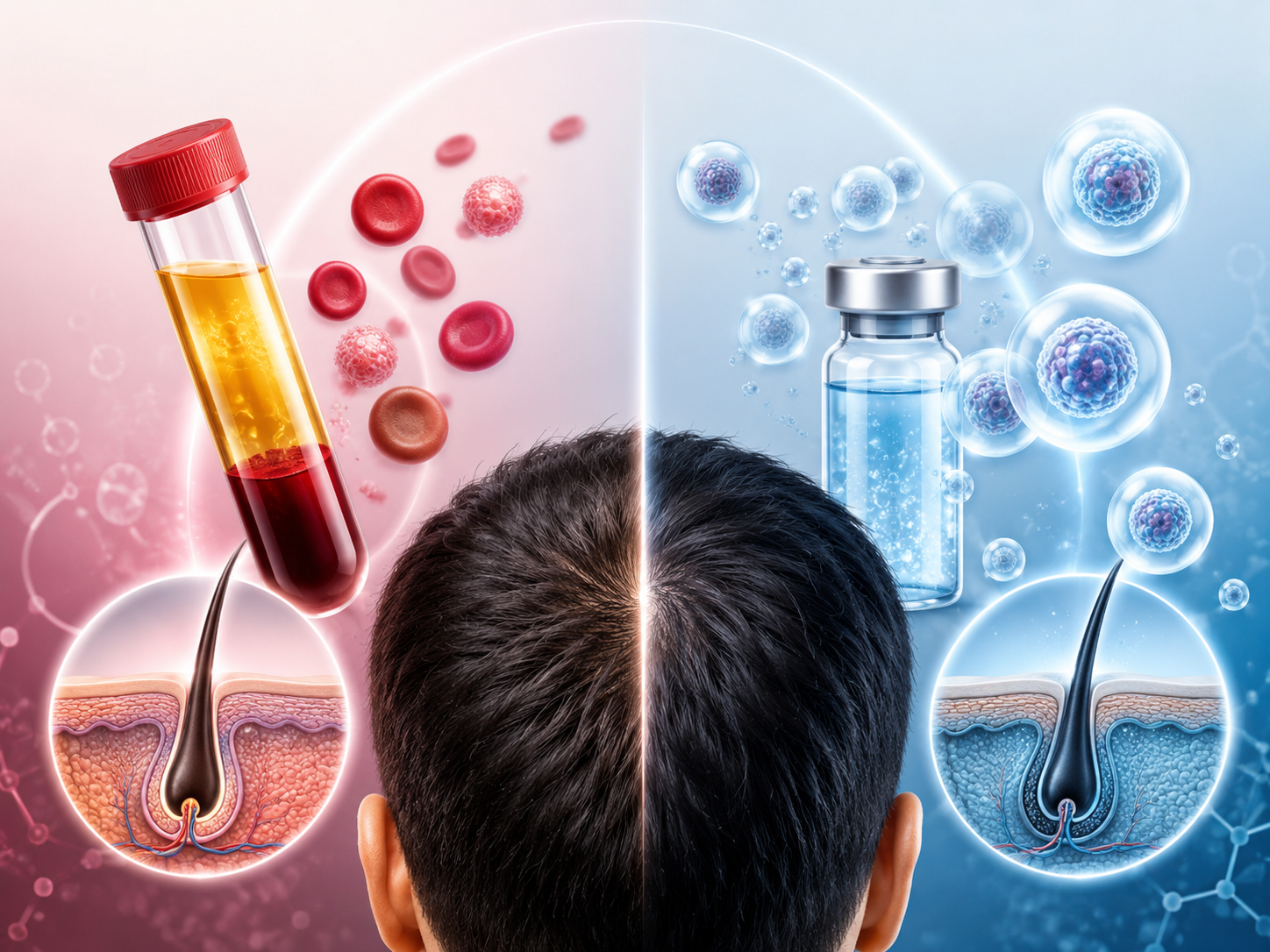
If you’ve been researching non-surgical options for hair loss, you’ve probably come across two treatments getting a lot of attention: PRP (platelet-rich plasma) and exosome therapy. Both aim to stimulate hair follicles and encourage regrowth, but they work differently — and knowing the difference matters before you invest time and money into either one.
This guide is written for anyone comparing PRP and exosome therapy for hair loss, whether you’re dealing with early thinning or more established hair loss and want to understand which approach might suit you better. We’ll cover how each treatment works, what the evidence says, realistic costs and timelines, and how a specialist decides which one — or which combination — is right for your specific hair loss pattern.
Not sure whether PRP or exosome therapy is right for your hair loss? Dr. Pankti’s REVIVE offers personalized hair consultations in Borivali. Call 9619758202 to book.
1. What Is PRP Therapy for Hair?
PRP, or platelet-rich plasma therapy, uses a concentrated portion of your own blood’s platelets, which contain growth factors that support tissue repair. A small blood sample is drawn, processed in a centrifuge to separate and concentrate the platelets, and then injected into areas of the scalp experiencing thinning. The growth factors are thought to stimulate hair follicles, potentially extending the growth phase of the hair cycle.
2. What Is Exosome Therapy for Hair?
Exosomes are tiny extracellular vesicles — essentially messenger particles released by cells — that carry proteins, growth factors, and genetic signals which can influence surrounding cells. In hair treatment, exosomes (often derived from stem cell cultures) are applied to the scalp, typically alongside microneedling, with the aim of signaling dormant or weakened hair follicles to become more active. Unlike PRP, exosome therapy doesn’t use your own blood — the exosomes come from a lab-processed source.
3. How PRP and Exosomes Work: Key Differences
The core difference lies in the source and mechanism: PRP uses your own blood’s platelets and their growth factors, while exosome therapy uses lab-derived vesicles that carry a broader, more concentrated signaling payload. Because exosomes are much smaller than platelets, some practitioners believe they may penetrate scalp tissue more efficiently, though this is still an active area of research rather than settled fact.
4. PRP vs Exosomes: Side-by-Side Comparison
| Feature | PRP Therapy | Exosome Therapy |
| Source | Patient’s own blood | Lab-derived (often stem cell-cultured) |
| Mechanism | Concentrated platelet growth factors | Cell-signaling vesicles with growth factors and proteins |
| Regulatory status | Well-established, widely used clinically | Newer, evolving regulatory landscape |
| Typical sessions | 3–4 initial sessions, then maintenance | Often fewer sessions per treatment cycle |
| Best suited for | Early to moderate androgenetic hair loss | Similar range; sometimes considered for cases with limited PRP response |
| Relative cost | Generally more affordable | Generally higher cost per session |
5. Who Is a Good Candidate for Each Treatment?
Both treatments tend to work best for people in the early to moderate stages of hair thinning, where follicles are weakened but not completely dormant. PRP has a longer track record and is often the first-line regenerative option a dermatologist will suggest. Exosome therapy may be considered for patients looking for a newer approach, those who haven’t seen the expected response from PRP alone, or as part of a combined treatment plan — always based on an individual scalp evaluation rather than a one-size-fits-all recommendation.
Wondering which treatment matches your hair loss stage? Dr. Pankti’s REVIVE in Borivali offers a detailed scalp and hair analysis before recommending PRP, exosomes, or both. WhatsApp or call 9619758202.
6. Effectiveness: What Does the Evidence Say?
PRP has a substantial body of clinical research supporting its use for androgenetic alopecia, with many studies showing improvements in hair density and thickness over multiple sessions. Exosome therapy is a newer field, and while early research and clinical experience are promising, the overall evidence base is still smaller and less standardized compared to PRP. This doesn’t mean exosome therapy doesn’t work — it means the science is still catching up, and expectations should be set accordingly.
7. Cost Comparison: PRP vs Exosomes
PRP therapy is generally more affordable per session since it uses the patient’s own blood with comparatively simple processing. Exosome therapy tends to cost more per session due to the specialized lab processing involved in producing the exosome product. Total cost for either treatment depends on the number of sessions recommended, which varies based on your specific hair loss pattern and goals — a personalized consultation is the most reliable way to get an accurate estimate.
8. Sessions Needed and Results Timeline
| Treatment | Typical Initial Sessions | When Results Become Visible |
| PRP | 3–4 sessions, spaced 4–6 weeks apart, then maintenance every few months | Gradual improvement over 3–6 months |
| Exosome Therapy | Often 2–4 sessions depending on protocol | Some practitioners report earlier visible changes, though individual response varies |
Both treatments require patience — hair growth is a gradual biological process, and neither PRP nor exosomes work overnight.
9. Safety and Side Effects
- PRP: Since it uses your own blood, allergic reactions are rare; common effects include mild scalp soreness, redness, or swelling at injection sites for a day or two.
- Exosomes: Generally well tolerated in early clinical use, with similar mild, temporary scalp reactions reported; because it’s a newer treatment, long-term safety data is still accumulating.
- Both: Should be performed by a qualified medical professional using sterile technique to minimize infection risk.
10. Can PRP and Exosome Therapy Be Combined?
Yes — combining PRP and exosome therapy is an increasingly common approach, aiming to pair PRP’s well-established growth factor delivery with the broader cell-signaling potential of exosomes. Whether combination therapy is right for you depends on your hair loss stage, budget, and how your scalp responds to initial treatment, and is best decided together with your treating dermatologist.
11. The Procedure: What to Expect
Both treatments are typically performed as in-clinic procedures lasting about 30–60 minutes. For PRP, a small blood draw is taken and processed on-site before injection into the scalp. For exosome therapy, the scalp is usually prepared with microneedling before the exosome solution is applied or injected. Local numbing cream is often used to minimize discomfort for both procedures, and most patients can resume normal activities the same day.
Curious what a PRP or exosome session actually feels like? Book a Hair Consultation with Dr. Pankti’s REVIVE, Borivali — Call or WhatsApp 9619758202.
12. Before & After Care Tips
Before Treatment
- Stay well hydrated and eat a normal meal beforehand
- Avoid blood thinners or anti-inflammatory medications if advised by your doctor
- Avoid alcohol for at least 24 hours prior
After Treatment
- Avoid washing your hair for the first 24 hours
- Avoid strenuous exercise or excessive sweating for a day or two
- Avoid hair coloring or chemical treatments for at least a week
- Follow your clinic’s specific aftercare instructions for the best results
13. Myths vs Facts About PRP and Exosome Hair Treatment
| Myth | Fact |
| PRP or exosomes can regrow hair on a completely bald scalp | Both treatments work best on follicles that are weakened but still present, not on areas with long-term, complete follicle loss |
| Exosome therapy is always better than PRP | Exosome therapy is promising but has less long-term clinical evidence than PRP; “better” depends on the individual case |
| One session is enough to see permanent results | Both treatments typically require multiple sessions plus ongoing maintenance for lasting benefit |
| These treatments can replace a hair transplant for advanced baldness | For advanced, long-standing hair loss, a hair transplant may still be the more effective option |
| PRP is risky because it involves blood | PRP uses your own blood, which is processed in a closed, sterile system, making allergic reactions very rare |
14. How to Choose the Right Treatment for You
The right choice depends on your stage of hair loss, budget, how your scalp has responded to any prior treatments, and your comfort with a newer versus more established option. Rather than choosing based on marketing claims alone, a proper scalp and hair loss evaluation — including an assessment of your hair loss pattern and follicle health — is the most reliable way to decide between PRP, exosomes, or a combined approach.
15. Common Mistakes to Avoid
- Expecting visible results after just one session
- Choosing a treatment based on price alone rather than suitability for your hair loss stage
- Skipping maintenance sessions once initial improvement is seen
- Getting treatment from an unlicensed or inexperienced provider
- Ignoring underlying causes of hair loss (like thyroid issues or nutritional deficiencies) that may need separate treatment
16. Frequently Asked Questions
What is the difference between PRP and exosomes for hair?
PRP uses concentrated growth factors from your own blood, while exosome therapy uses lab-derived cell-signaling particles, often from stem cell cultures, to stimulate hair follicles.
Which is better for hair loss, PRP or exosomes?
Neither is universally “better” — PRP has more established clinical evidence, while exosome therapy is newer and may suit specific cases; the right choice depends on individual evaluation.
How does PRP therapy work for hair regrowth?
PRP concentrates platelets from your blood, which release growth factors when injected into the scalp, potentially stimulating hair follicles and extending the hair growth phase.
How does exosome therapy work for hair regrowth?
Exosomes carry proteins and growth signals that may activate dormant or weakened hair follicles when applied to the scalp, often alongside microneedling.
Is exosome therapy more expensive than PRP?
Yes, exosome therapy generally costs more per session than PRP due to the specialized lab processing required to produce the exosome product.
How many PRP sessions are needed for visible results?
Most protocols involve 3–4 initial sessions spaced several weeks apart, followed by maintenance sessions every few months for continued benefit.
Are exosomes safe for hair treatment?
Early clinical use suggests exosome therapy is generally well tolerated, though as a newer treatment, long-term safety data is still being gathered.
Can PRP and exosome therapy be combined?
Yes, combining both is increasingly common in practice, aiming to pair PRP’s established benefits with the broader signaling potential of exosomes.
Does PRP hair treatment hurt?
Most patients experience only mild discomfort during injections, especially with numbing cream applied beforehand; any soreness afterward is usually brief.
How long do PRP hair treatment results last?
Results can last several months to over a year, though ongoing maintenance sessions are generally needed to sustain improvement over time.
What are exosomes exactly?
Exosomes are tiny vesicles released by cells that carry proteins, growth factors, and genetic material, allowing them to influence the behavior of nearby cells.
Is exosome therapy approved for hair loss treatment?
Regulatory status for exosome therapy varies by region and is still evolving; it’s important to choose a qualified clinic that sources exosome products responsibly.
Can women benefit from PRP or exosome hair treatment?
Yes, both treatments are used for female pattern hair loss as well as male pattern hair loss, with candidacy assessed individually.
What type of hair loss responds best to PRP?
PRP tends to work best for early to moderate androgenetic (pattern) hair loss where follicles are thinning but still active.
What type of hair loss responds best to exosomes?
Exosome therapy is generally considered for similar hair loss stages as PRP, and is sometimes explored when PRP alone hasn’t produced the expected results.
How soon can I see results from exosome therapy?
Some patients report early changes within a couple of months, though full results typically build gradually over several months, similar to PRP.
Is PRP hair treatment permanent?
No single session provides permanent results — ongoing maintenance sessions are typically needed to sustain hair density improvements over time.
Can PRP or exosomes replace a hair transplant?
For early to moderate thinning, they can meaningfully improve density, but for advanced, long-standing baldness, a hair transplant is often still the more effective option.
What is the recovery time after PRP or exosome hair treatment?
Recovery is minimal for both — most patients return to normal activities the same day, with only mild, temporary scalp soreness or redness.
How do I know which treatment is right for my hair loss stage?
A professional scalp and hair loss evaluation is the most reliable way to determine whether PRP, exosomes, or a combination best matches your specific pattern of hair loss.
17. Key Takeaways
- PRP uses your own blood’s growth factors; exosome therapy uses lab-derived signaling particles
- PRP has a longer clinical track record; exosome therapy is newer with a growing but smaller evidence base
- Both work best on weakened but still-active hair follicles, not completely bald areas
- Combining PRP and exosome therapy is an increasingly used approach for some patients
- A personalized scalp evaluation is the most reliable way to choose between the two
Conclusion
Both PRP and exosome therapy offer genuine, science-backed potential for improving hair density in the right candidates — the key is matching the treatment (or combination) to your specific hair loss pattern rather than choosing based on trends alone. PRP remains the more established, well-researched option, while exosome therapy is an exciting, evolving addition to the hair restoration toolkit.
Dr. Pankti’s REVIVE Multispeciality Clinic in Borivali offers personalized PRP and exosome hair treatment consultations, serving patients across Borivali, Kandivali, Malad, Goregaon, and greater Mumbai.
Ready to find out which treatment suits your hair loss stage? Book Your Hair Consultation today — Call or WhatsApp 9619758202, or visit www.drpanktisrevive.com.