

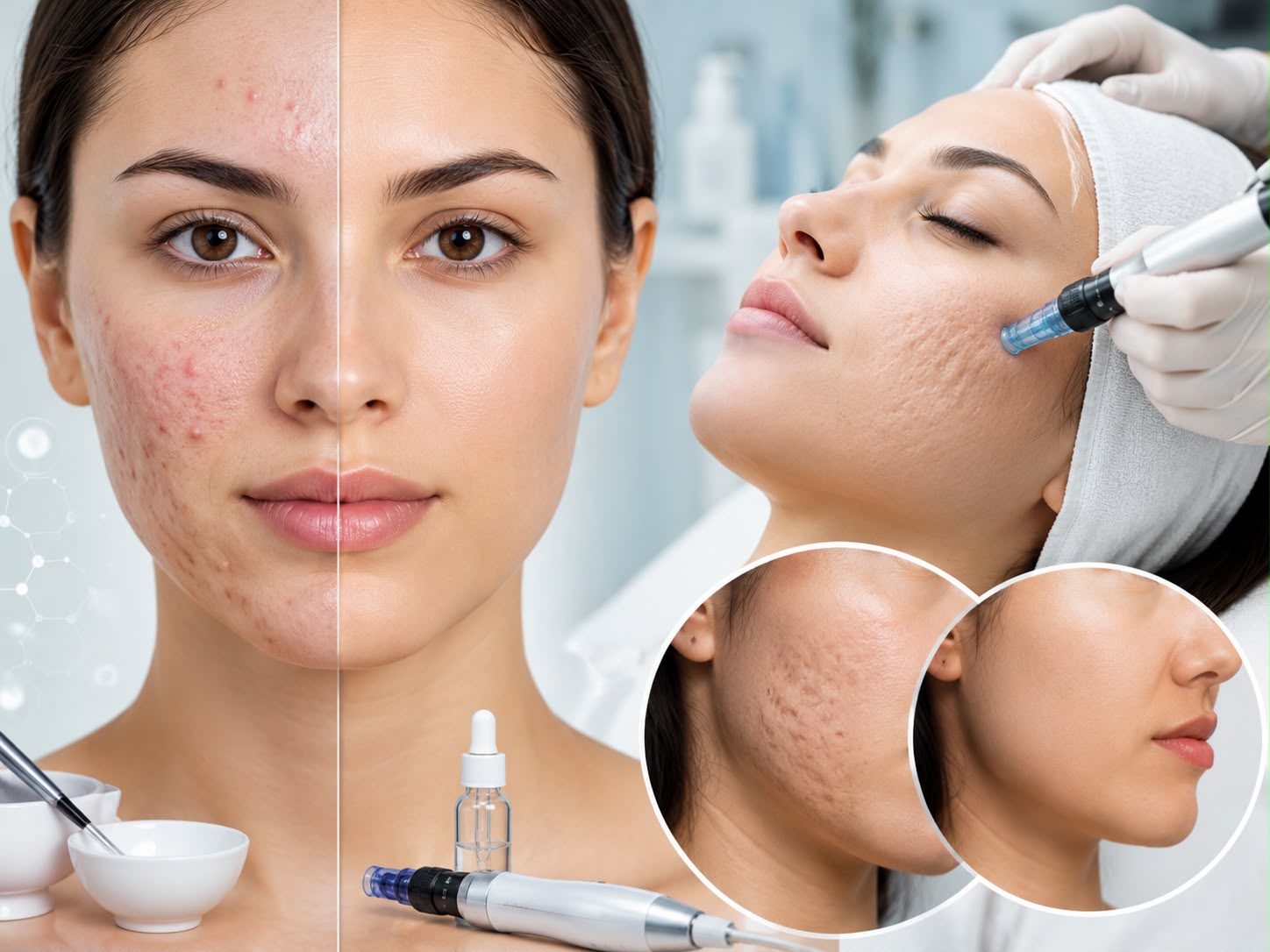
Acne can be tough enough to deal with — but the marks and scars it sometimes leaves behind can feel even harder to shake. If you’ve cleared your breakouts but are still looking at pitted, uneven, or discolored skin in the mirror, you’re not alone, and there’s more you can do than you might think. This guide is written for anyone exploring acne scar treatment, whether you’re just starting to research options or you’ve already tried a few things without the results you hoped for.
You’ll learn about the different types of acne scars, which treatments actually work for each type, what results and recovery realistically look like, and how to avoid wasting time and money on the wrong approach. We’ve also included guidance on safely treating acne scars on Indian skin tones, and when a professional evaluation is worth prioritizing over more DIY experimenting.
Not sure which acne scar treatment suits your skin? Dr. Pankti’s REVIVE offers professional skin analysis in Borivali. Call 9619758202 to book a consultation.
1. What Are Acne Scars?
Acne scars are marks left on the skin after a breakout heals, caused by changes to the skin’s collagen during the healing process. When inflamed acne damages the deeper layers of skin, the body sometimes produces too little or too much collagen while repairing it — leading to depressed (pitted) scars or raised scars, depending on the type of damage.
Not every mark left behind by acne is a true scar. Many people also deal with flat red or brown marks called post-inflammatory pigmentation, which usually fade on their own over time and need a different approach than actual textural scarring.
2. Types of Acne Scars
Acne scars generally fall into a few recognizable categories, and knowing which type you have is the single most useful step before choosing a treatment.
| Scar Type | Appearance | Common Cause |
| Icepick scars | Narrow, deep, pinpoint pits | Severe, deeply inflamed cystic acne |
| Boxcar scars | Wider, box-shaped depressions with defined edges | Loss of tissue from moderate to severe acne |
| Rolling scars | Broad, shallow depressions with a wave-like texture | Fibrous bands pulling skin down from below |
| Hypertrophic/keloid scars | Raised, thickened scar tissue | Excess collagen production during healing |
3. What Causes Acne Scars to Form?
- Deep, cystic, or nodular acne that damages deeper skin layers
- Picking, popping, or squeezing pimples, which increases inflammation and damage
- Delayed or inadequate treatment of active, inflamed acne
- Genetic tendency toward certain scar types, including keloids
- Repeated breakouts in the same area over time
4. Acne Scars vs Acne Marks: Know the Difference
| Feature | Acne Scar | Acne Mark (Pigmentation) |
| Texture | Pitted, raised, or uneven | Flat, same texture as surrounding skin |
| Color | Often skin-toned or slightly discolored | Red, pink, or brown discoloration |
| Fades on its own? | No, needs active treatment | Usually fades over months with sun protection |
| Best first step | Dermatologist evaluation for scar-specific treatment | Sun protection, gentle brightening skincare |
5. Risk Factors for Scarring
- Having severe, cystic, or nodular acne rather than mild breakouts
- Delaying treatment for active acne
- Picking or squeezing pimples
- Family history of scarring or keloid formation
- Acne on the jawline, cheeks, or back, which scars more easily for some people
6. How Acne Scars Are Diagnosed and Evaluated
A dermatologist typically diagnoses and classifies acne scars through a visual skin examination, often assessing scar depth and type under good lighting or magnification. This evaluation is what actually determines which treatment — or, more often, which combination of treatments — will work best, since icepick, boxcar, and rolling scars each respond differently to the same procedure.
Get an accurate scar assessment instead of guessing what might work. Dr. Pankti’s REVIVE in Borivali offers detailed skin analysis to map out the right treatment plan. WhatsApp or call 9619758202 to schedule.
7. Treatment Options for Acne Scars
Laser Resurfacing
Fractional CO2 and erbium lasers work by creating controlled micro-injuries that stimulate new collagen production, gradually smoothing pitted scars over a series of sessions. Laser settings need to be adjusted carefully for darker skin tones to reduce the risk of pigmentation changes.
Microneedling (including RF Microneedling)
Microneedling uses fine needles to trigger the skin’s own collagen-repair response. Radiofrequency (RF) microneedling combines this with heat energy for added collagen stimulation, and is often used for rolling and shallow boxcar scars.
Subcision
A minor procedure where a needle is used to release the fibrous bands tethering rolling scars to deeper tissue, allowing the skin surface to lift and appear smoother — often combined with other treatments for best results.
Chemical Peels
Peels using glycolic, salicylic, or TCA (trichloroacetic acid) solutions can improve mild scarring and pigmentation by encouraging controlled skin renewal. TCA CROSS is a specialized technique used specifically for deep icepick scars.
Dermal Fillers
Hyaluronic acid fillers can temporarily fill in rolling or boxcar scars, offering a faster but non-permanent improvement, often used for people wanting visible results before an event.
PRP (Platelet-Rich Plasma)
PRP uses a concentration of the patient’s own platelets to support the skin’s healing and collagen response, and is often combined with microneedling for enhanced results.
8. Matching Treatment to Scar Type
| Scar Type | Typically Best-Suited Treatments |
| Icepick scars | TCA CROSS, fractional laser |
| Boxcar scars | Fractional laser, microneedling, dermal fillers |
| Rolling scars | Subcision combined with microneedling or laser |
| Hypertrophic/keloid scars | Steroid injections, laser, sometimes silicone-based treatment |
Most patients with more than one scar type benefit from a combination approach rather than a single treatment — this is something a dermatologist can plan out during an initial consultation.
9. Latest Advances in Acne Scar Treatment
Combination protocols — such as pairing subcision with RF microneedling and PRP in a single treatment plan — have become increasingly common because they address multiple aspects of scarring (depth, tethering, and collagen quality) at once rather than relying on one method alone. Devices have also become more precise, allowing more targeted energy delivery with less downtime and better safety margins for different skin tones.
10. Results Timeline: What to Expect and When
| Treatment | Typical Sessions Needed | When Results Become Visible |
| Microneedling / RF Microneedling | 4–6 sessions, spaced weeks apart | Gradual improvement over 2–3 months |
| Fractional Laser Resurfacing | 3–5 sessions | Visible smoothing over 1–3 months per session |
| Subcision | 1–3 sessions, often combined with other treatments | Improvement over several weeks as skin settles |
| Chemical Peels | 4–6 sessions | Gradual texture improvement over weeks |
| Dermal Fillers | Single session | Immediate, lasting 6–18 months |
Acne scar treatment is almost always a gradual process. Collagen remodeling takes time, so most visible improvement builds steadily over months rather than appearing after a single session.
11. Who Is a Good Candidate? Who Should Avoid Certain Treatments?
Good candidates: People with stable, non-active acne, realistic expectations about gradual improvement, and no active skin infections in the treatment area.
Treatments may need to be modified or delayed for: People with active, inflamed acne breakouts (treating scars while acne is still active can worsen inflammation), those on certain acne medications like isotretinoin (which usually requires a treatment-free gap), individuals prone to keloid scarring (who need extra caution with resurfacing procedures), and pregnant or breastfeeding individuals for certain energy-based or chemical treatments.
12. Cost of Acne Scar Treatment
Cost varies widely depending on scar severity, treatment type, number of sessions, and clinic expertise. Combination treatment plans (for example, subcision plus microneedling) typically cost more per session than a single microneedling or peel session, but may need fewer overall sessions to reach a satisfying result. The most reliable way to get an accurate cost estimate is a personalized consultation, since pricing should reflect your specific scar type and goals rather than a generic package.
Get a personalized treatment plan and transparent cost estimate. Book a Skin Consultation with Dr. Pankti’s REVIVE, Borivali — Call or WhatsApp 9619758202.
13. Possible Side Effects and Complications
- Temporary redness, swelling, or sensitivity after laser or microneedling sessions
- Mild peeling or dryness following chemical peels
- Temporary darkening (post-inflammatory hyperpigmentation), more common with inadequate sun protection or aggressive settings on darker skin
- Rare risk of infection if aftercare instructions aren’t followed
- Filler-related swelling or, rarely, lump formation, which usually resolves or can be corrected
Choosing an experienced provider who tailors treatment intensity to your skin type significantly reduces these risks.
14. Before & After Care Tips
Before Treatment
- Avoid active acne breakouts, sunburn, or recent tanning in the treatment area
- Inform your doctor about any medications, especially isotretinoin or blood thinners
- Avoid harsh exfoliants or retinoids for a few days prior, as advised by your dermatologist
After Treatment
- Apply broad-spectrum sunscreen diligently, especially in the weeks following treatment
- Avoid picking at any peeling or scabbing skin
- Follow your clinic’s specific aftercare routine, including any recommended soothing creams
- Avoid strenuous exercise or excessive sweating for the first day or two after energy-based treatments
15. Home Remedies: What Actually Helps (and What Doesn’t)
For very mild scarring or lingering pigmentation, consistent sun protection and gentle skincare (like products with niacinamide or azelaic acid) can support the skin’s natural fading process. However, home remedies cannot rebuild lost collagen or fix textural depressions the way in-clinic procedures can — it’s important to have realistic expectations about what skincare alone can achieve for true scarring versus surface marks.
- Daily SPF 30+ sunscreen to prevent scars and marks from darkening further
- Gentle cleansing rather than harsh scrubbing, which can worsen inflammation
- Niacinamide or azelaic acid-based products to support even skin tone
- Avoiding DIY extractions or aggressive at-home devices, which can worsen scarring
16. How to Prevent New Acne Scars
The most effective way to reduce acne scarring is treating active acne early and avoiding picking at breakouts. If you’re still dealing with active acne, addressing that first — often alongside scar-prevention skincare — gives the best long-term results.
- Treat active acne promptly rather than waiting for it to resolve on its own
- Avoid squeezing, popping, or picking at pimples
- Use non-comedogenic skincare and sunscreen daily
- See a dermatologist early for cystic or nodular acne, which carries the highest scarring risk
Currently dealing with active breakouts as well as old scarring? Dr. Pankti’s REVIVE, serving Borivali, Kandivali, Malad, and Goregaon, can build a combined acne-and-scar treatment plan. Call 9619758202.
17. Common Mistakes That Delay Results
- Starting scar treatment while acne is still active and inflamed
- Expecting one session to fully resolve deep scarring
- Skipping sunscreen after treatment, which can worsen pigmentation
- Choosing a single treatment type when a combination approach would work better
- Picking at peeling skin during the healing phase
18. Frequently Asked Questions
What is the most effective treatment for acne scars?
There’s no single “best” treatment for everyone — effectiveness depends on scar type. Icepick scars often respond well to TCA CROSS or laser, while rolling scars usually need subcision combined with microneedling or laser.
Can acne scars be completely removed?
Most treatments significantly improve the appearance of acne scars rather than erasing them entirely. Realistic goals are smoother texture and reduced visibility, especially with a well-planned combination approach.
What are the different types of acne scars?
The main types are icepick (narrow, deep pits), boxcar (wider box-shaped depressions), rolling (broad, wavy depressions), and hypertrophic or keloid scars (raised tissue).
Is laser treatment safe for acne scars?
Yes, when performed by an experienced provider using settings appropriate for your skin tone. Darker skin requires careful calibration to reduce the risk of pigmentation changes.
How much does acne scar treatment cost?
Cost depends on scar severity, treatment type, and number of sessions needed. A personalized consultation is the most reliable way to get an accurate estimate for your specific case.
How many sessions does acne scar treatment need?
Most treatments require multiple sessions — often 3 to 6 — spaced weeks apart, since collagen remodeling is a gradual process rather than an instant fix.
What is the difference between acne scars and acne marks?
Acne scars involve textural changes like pitting or raised tissue, while acne marks are flat discoloration (red, pink, or brown) that usually fades on its own over time.
Does microneedling really work for acne scars?
Yes, microneedling stimulates the skin’s own collagen production and shows good results for rolling and shallow boxcar scars, typically over a series of sessions.
Is subcision painful?
Subcision is performed with local anesthesia, so discomfort during the procedure is minimal; some soreness or bruising can occur for a few days afterward.
Can dark or sensitive skin undergo laser treatment safely?
Yes, with appropriately adjusted settings and an experienced provider. Darker skin tones do carry a higher risk of post-treatment pigmentation, so calibration and aftercare matter more.
How long is recovery after acne scar treatment?
Recovery varies by treatment — microneedling and peels often involve a few days of redness, while more intensive laser resurfacing may need a week or more of downtime.
Can home remedies fix deep acne scars?
No, home remedies can support skin tone and mild surface marks but cannot rebuild the collagen loss responsible for deep, pitted scarring.
What is the best age to start acne scar treatment?
There’s no fixed age requirement — treatment is generally recommended once active acne is under control, regardless of age, though a dermatologist will assess individual skin readiness.
Do chemical peels help with acne scars?
Yes, particularly for mild scarring and pigmentation. Deeper scars often need peels combined with other treatments like microneedling or laser for better results.
Can acne scars come back after treatment?
Existing scars generally don’t return once improved, but new scars can form if active acne breakouts continue untreated.
What is PRP treatment for acne scars?
PRP uses a concentration of your own blood’s platelets to support the skin’s healing response, often combined with microneedling to enhance collagen production.
How do I know which acne scar treatment is right for me?
A dermatologist evaluation is the most reliable way to match your specific scar types to the right treatment or combination of treatments.
What should I avoid after acne scar treatment?
Avoid sun exposure without sunscreen, picking at healing skin, and harsh exfoliants or active ingredients until your provider confirms your skin has fully recovered.
Can diet affect acne scarring?
Diet’s direct effect on existing scars is limited, but a balanced diet supports overall skin healing and can help manage active acne, which reduces the risk of new scarring.
Is it possible to prevent acne scars before they form?
Yes — treating active, inflamed acne early and avoiding picking at breakouts are the two most effective ways to reduce the risk of permanent scarring.
19. Key Takeaways
- Acne scars come in several distinct types, and identifying yours is the key first step
- Treatment works best as a gradual, multi-session process — sometimes combining more than one method
- Laser resurfacing, microneedling, subcision, peels, fillers, and PRP each suit different scar types
- Sun protection and gentle skincare matter both before and after treatment
- Treating active acne early is the most effective way to prevent new scars from forming
Conclusion
Acne scars can take time to improve, but with the right diagnosis and treatment plan, meaningful, lasting improvement is realistic for most people. The key is matching the treatment to your specific scar type — and that starts with a proper skin evaluation rather than trial-and-error with products or generic treatments.
Dr. Pankti’s REVIVE Multispeciality Clinic in Borivali offers detailed skin analysis and personalized acne scar treatment plans, serving patients across Borivali, Kandivali, Malad, Goregaon, and greater Mumbai.
Ready to start your acne scar treatment journey? Book Your Skin Consultation today — Call or WhatsApp 9619758202, or visit www.drpanktisrevive.com.