
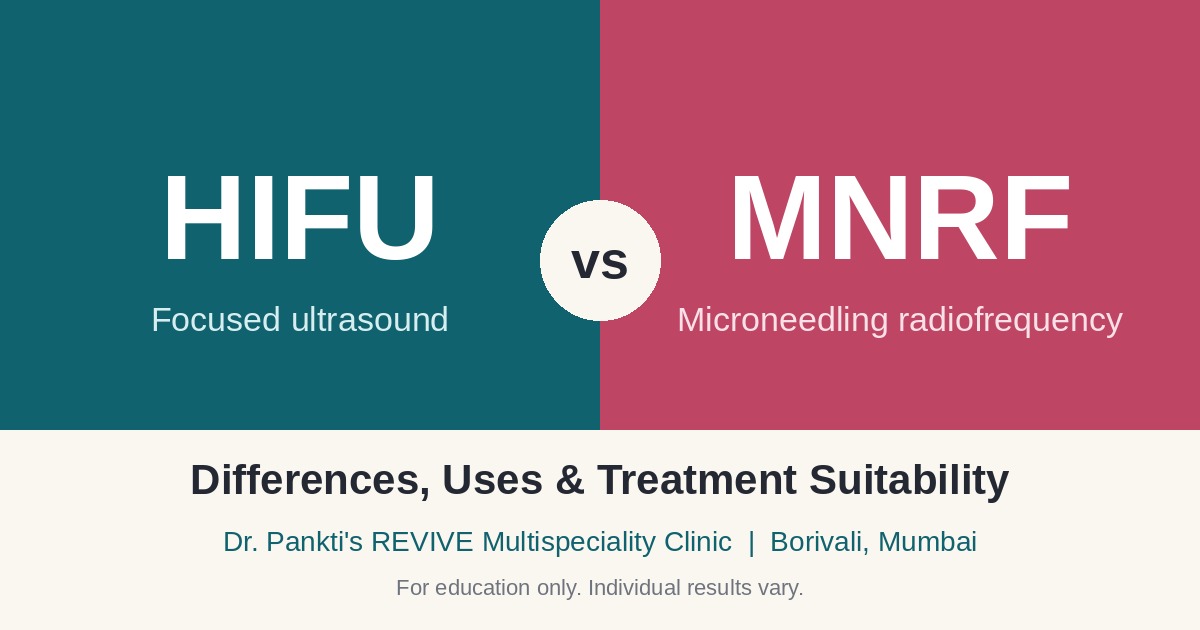
- HIFU vs MNRF comes down to depth and purpose. HIFU (high-intensity focused ultrasound) sends focused ultrasound energy into deeper layers to help lift and tighten mild-to-moderate skin laxity. MNRF (microneedling radiofrequency) uses fine needles
- HIFU is mainly considered for mild-to-moderate sagging of the lower face, jawline, neck and brow.
- MNRF is mainly considered for acne scars, uneven texture, enlarged pores and fine lines.
- Neither treatment replaces a surgical facelift, and results vary from person to person.
- A doctor’s assessment should decide which, if either, is suitable for you.
What is HIFU skin tightening?
HIFU stands for high-intensity focused ultrasound. A handheld device sends focused ultrasound energy beneath the skin surface. This creates tiny points of heat in deeper tissue and prompts the body’s natural collagen-building response, as Cleveland Clinic explains for ultrasound lifting. The skin surface is not cut.
There is one important point about terminology. The best-studied version is called microfocused ultrasound with visualisation (MFU-V). A published review notes that this type is cleared by the US FDA for lifting the brow and the tissue under the chin and neck, and for improving lines on the upper chest. However, many other devices are sold as “HIFU”. An expert review points out that their regulatory status and supporting evidence can differ. So it is reasonable to ask your doctor which device is used.
You can read how the procedure is carried out at our clinic on the HIFU treatment page.
What is MNRF (microneedling radiofrequency)?
MNRF combines two ideas. First, very fine needles create controlled micro-channels in the skin. Second, radiofrequency energy is delivered through those needles into the dermis, the layer that holds collagen. It is also called fractional radiofrequency microneedling.
A review in Dermatologic Surgery found studies of this approach for skin rejuvenation, acne scars, stretch marks and several other concerns. It also reported that new collagen formation is slow and progressive, and can keep improving for up to six months.
Importantly, a systematic review in skin of color found a low risk of scarring or pigmentation change. The authors added that many of the studies were not high quality.
Please note that MNRF is different from the non-needle radiofrequency treatment described on our RF treatment page, which focuses on body contouring and skin tightening. Ask your doctor to explain which technology is being recommended.
HIFU vs MNRF: key differences at a glance
| Feature | HIFU | MNRF |
|---|---|---|
| Energy used | Focused ultrasound | Radiofrequency delivered through fine needles |
| Needles | No | Yes |
| Main target | Deeper tissue that supports the skin | The dermis (collagen-rich layer) |
| Commonly discussed for | Mild-to-moderate laxity of the lower face, jawline, neck and brow | Acne scars, texture, pores, fine lines |
| Typical sensation | Warmth or tingling during treatment | Stinging or pressure; numbing cream is commonly used |
| Downtime | Usually little or none | Temporary redness and swelling are the most commonly reported effects |
| Result timeline | Gradual, often assessed after about 3 months | Gradual, may keep improving for up to 6 months |
| Number of sessions | Decided by your doctor | A series is usually planned; decided by your doctor |
These are general patterns, not promises. Your doctor will adjust the plan to your skin.
Which concerns suit HIFU, and which suit MNRF?
HIFU may be considered when:
- You notice mild-to-moderate sagging around the jawline, cheeks, neck or brow.
- You want a non-surgical option with little downtime.
- You are not ready for, or do not need, surgery.
Cleveland Clinic notes that ultrasound lifting suits people with mild to moderate extra skin, and that it is not a replacement for a surgical facelift.
MNRF may be considered when:
- You have atrophic (depressed) acne scars. A 2026 meta-analysis found it may work similarly to fractional laser, with shorter downtime. The authors still call for better studies.
- You want to improve rough texture, visible pores or fine lines.
- You have mild skin laxity along with texture concerns.
Other concerns may need other approaches. Dark acne marks, dullness or uneven tone are often managed differently. For example, you may be advised to explore a chemical peel or a Hydrafacial. You can also browse all skin treatment services at REVIVE.
Who may not be suitable? Safety comes first
Not everyone is a candidate for energy-based treatments. Doctors usually check for the following before recommending either option:
- Active infection, open wounds or inflamed acne in the treatment area.
- Pregnancy or breastfeeding.
- A pacemaker or other implanted electronic device (especially important for radiofrequency).
- A tendency to form keloid or raised scars.
- Recent fillers, other procedures or certain medicines.
- Very significant sagging, which may be better addressed with surgery.
Temporary redness, swelling, tenderness and tingling are commonly reported. Less common problems, such as pigmentation change or burns, are more likely when treatment is not suited to the person or is not delivered correctly. This is why a proper assessment and an experienced clinician matter.
Realistic expectations: results, sessions and downtime
It helps to keep expectations balanced. Neither treatment gives instant, permanent or identical results.
For HIFU, one trial summarised in a clinical review measured a modest average brow lift of about 1.7 mm at 90 days. In the same review, blinded assessment of photographs found improvement under the chin and neck in roughly two-thirds of people. In other words, changes are often subtle and gradual. As noted on our HIFU page, repeat sessions may be discussed after one to two years.
For MNRF, improvement is progressive. Your doctor will explain how many sessions are suitable for your skin and how far apart they should be.
In both cases, good aftercare supports comfort. Our HIFU aftercare guidance includes avoiding hot water, heavy sweating and sun exposure for a period, and using sunscreen daily. Because Mumbai’s heat and humidity make sweating hard to avoid, ask your doctor to help you plan the timing of your session.
How do skin treatments fit with hair, PRP and homeopathy care?
HIFU and MNRF are skin treatments. They are not treatments for hair fall. Research on radiofrequency microneedling for hair loss is still very limited; the Dermatologic Surgery review above found only one study. If you also have thinning or shedding, a separate evaluation is more useful. You can read about our hair loss treatment, female hair loss care and Biotin PRP.
Some patients also ask about homeopathy alongside cosmetic care. It is offered as a separate holistic consultation. It is not a substitute for HIFU or MNRF, and it has not been shown to tighten skin.
HIFU vs MNRF in Borivali, Mumbai: what to expect at a consultation
A good consultation should feel unhurried. At Dr. Pankti’s REVIVE Multispeciality Clinic, you can expect:
- A discussion of your main concern and your goals.
- A medical history, including medicines, allergies and previous procedures.
- An examination of your skin type, laxity, scars and pigmentation.
- An explanation of suitable options, including non-device options, with risks and limits.
- Clear information on cost, sessions and aftercare before you decide.
The clinic serves patients across Mumbai’s western suburbs, with branches for Borivali, Kandivali, Malad and Goregaon. If you live nearby, you can choose the location that is easiest to reach.
Frequently asked questions about HIFU vs MNRF
Is HIFU or MNRF better for skin tightening? HIFU is more commonly discussed for lifting mild-to-moderate sagging of the lower face and neck. MNRF is more commonly discussed for texture and scars, with some tightening effect. Neither is “better” for everyone. Your doctor will match the treatment to your concern.
Which is better for acne scars: HIFU or MNRF? MNRF has more published evidence for atrophic acne scars. A systematic review describes it as a promising option, including in skin of color. HIFU is not usually the first choice for scars. A clinician should first identify your scar type.
Does MNRF involve downtime? Often a little. Temporary redness, swelling and tenderness are the most commonly reported effects, and a systematic review describes downtime as minimal. How long they last depends on the device settings and your skin, so ask your doctor what to expect.
How long do HIFU results last? Results are gradual and not permanent, because skin keeps ageing. Our HIFU page notes that repeat treatment may be considered after one to two years. Lifestyle, sun exposure and skin quality also influence how long the effect is noticeable.
Are HIFU and MNRF safe for Indian skin? Research suggests both can be used in darker skin types with a low risk of pigmentation change. For example, a review of energy devices in skin of color found that these technologies work independently of skin colour. Even so, safety depends on correct settings and proper selection of patients.
Can I have HIFU and MNRF together? Sometimes. Doctors may plan treatments in sequence or at different times, depending on your goals. Whether that suits you, and how far apart sessions should be, is a medical decision. Do not combine treatments on your own.
Book an appointment enquiry
If you are unsure whether HIFU, MNRF or another option fits your skin, a consultation is the best first step. Our doctors will assess your skin and explain the benefits, limits and risks in a clear way. No result can be guaranteed, and individual outcomes vary.
Book your consultation | Contact the clinic | Call 09619758202 (Mon-Sat, 10 AM-7 PM)