
Introduction: Why Understanding Hair Regrowth Science
Matters
If you’ve noticed thinning hair on your pillow, clogging your shower drain, or widening your
parting, you’re not alone. Hair loss affects millions of Indians — and the good news is tha
modern science has unlocked powerful, evidence-based solutions to stimulate genuine hair
regrowth.
The science of hair regrowth isn’t just about slapping on an oil or popping a supplement.
It’s a complex biological process involving follicle biology, hormones, stem cells, growth
factors, and the right clinical intervention at the right time. Understanding how hair grows
back — and why it sometimes doesn’t — is the foundation of every effective treatment plan.
At Dr. Pankti’s REVIVE, one of Mumbai’s most trusted dermatology and trichology clinics
serving Borivali, Kandivali, Malad, Goregaon, and the wider western suburbs, we combine
cutting-edge science with personalised care to help patients achieve real, lasting hair
regrowth. Whether you’re looking for a hair specialist near me, a PRP hair treatment in
Borivali, or a hair transplant in Mumbai, understanding the science first helps you make
the best decision for your hair health.
Understanding the Hair Growth Cycle
Every strand of hair on your scalp goes through a well-defined, cyclical process. Disruption
at any stage can trigger shedding and impair regrowth.
The Four Phases of Hair Growth
| Phase | Phase Name | Duration | What Happens |
|---|---|---|---|
| 1The Hair Follicle — The Engine of Regrowth | Anagen (Growth) | 2–7 years | Active cell division; hair grows approximately 1 cm per month |
| 2 | Catagen (Transition) | 2–3 weeks | Hair follicle shrinks and hair growth stops |
| 3 | Telogen (Resting) | 3–4 months | Hair rests while a new hair begins forming underneath |
| 4 | Exogen (Shedding) | Ongoing | Old hair sheds naturally and the hair growth cycle restarts |
At any given time, approximately 85–90% of your scalp hairs are in the anagen phase, 1–
2% in catagen, and 10–15% in telogen. Losing 50–100 hairs per day is entirely normal and
part of healthy exogen shedding.
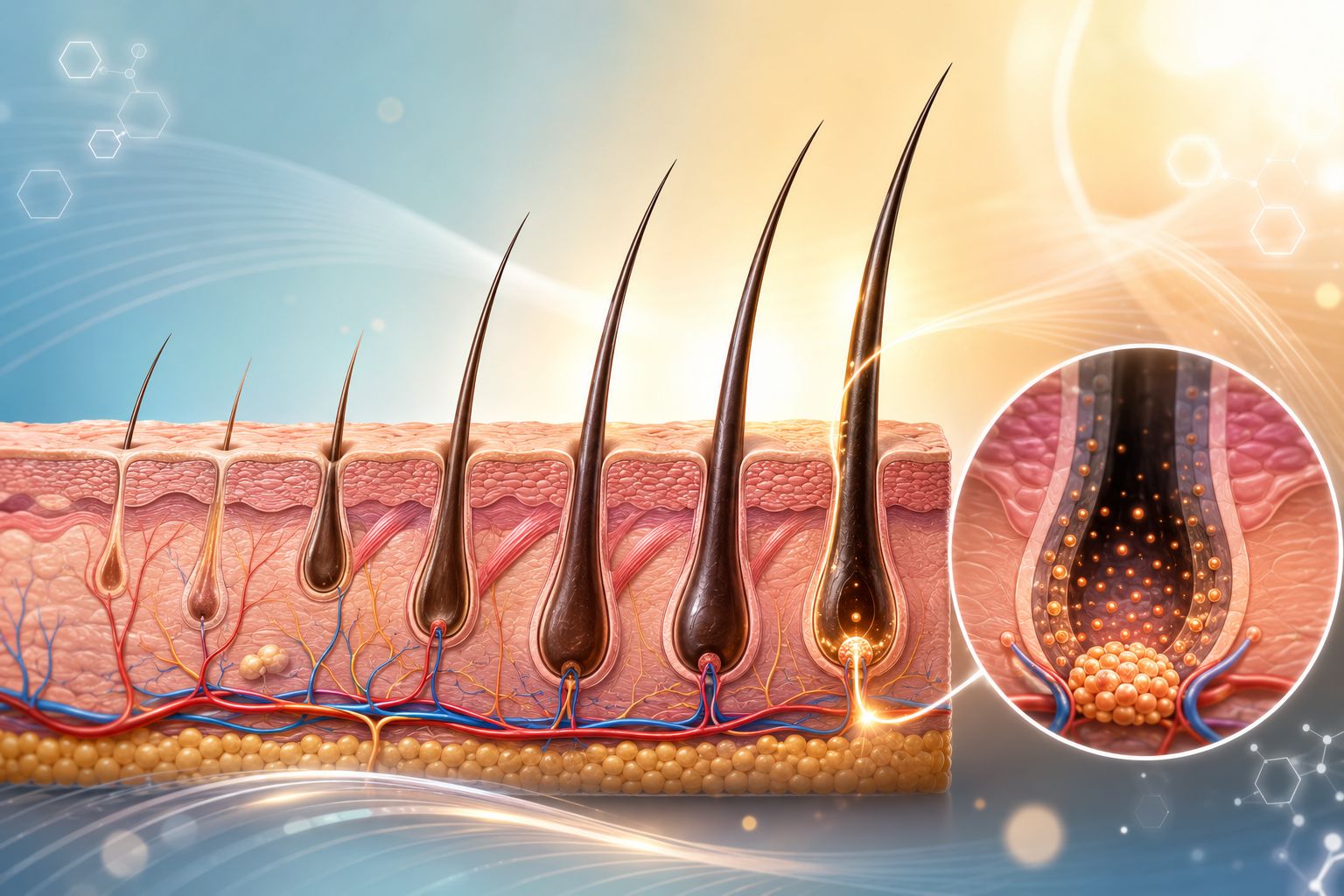
The Hair Follicle — The Engine of Regrowth
The hair follicle is a miniature organ embedded in your scalp. The dermal papilla, a cluster
of specialised cells at the follicle base, is the control centre for hair growth. It communicates
with stem cells in the bulge region of the follicle to trigger new growth cycles.
When follicles are healthy, the cycle continues indefinitely. When they are damaged by DHT
(dihydrotestosterone), inflammation, nutritional deficiency, or scarring, the anagen phase
shortens progressively — resulting in finer, shorter hairs, and eventually no hair at all.
Key Science Insight: Hair follicles don’t die easily. In most types of hair loss, the
follicle is dormant — not dead — which is why timely, science-backed treatment can
successfully reactivate regrowth.
What Causes Hair Loss?
Understanding the root cause is essential before choosing a hair regrowth treatment. The
most common causes include:
Androgenetic Alopecia (Pattern Hair Loss)
The most prevalent form affecting both men and women. Driven by a genetic sensitivity to
DHT (dihydrotestosterone), which binds to follicle receptors and progressively
miniaturises them. In men, this presents as a receding hairline and crown thinning
(Hamilton-Norwood scale). In women, it typically causes diffuse thinning at the crown
(Ludwig scale).
Telogen Effluvium
A sudden, widespread shedding triggered by physical or emotional shock — illness, surgery,
crash dieting, childbirth, COVID-19, or severe stress. Large numbers of follicles shift
prematurely into the telogen phase simultaneously. The good news: this type of hair loss islargely reversible.
Alopecia Areata
An autoimmune condition where the immune system mistakenly attacks hair follicles,
causing patchy bald spots. Can progress to total scalp (alopecia totalis) or body hair loss
(alopecia universalis).
PCOS-Related Hair Loss
In women with polycystic ovarian syndrome (PCOS), elevated androgens trigger hair
thinning similar to male pattern baldness. This is one of the most commonly missed causes
of hair loss in young Indian women, and PCOS-related hair loss treatment requires a
hormonal and trichological approach.
Nutritional Deficiencies
Iron-deficiency anaemia, low ferritin, vitamin D deficiency, zinc deficiency, and low B12 are
major triggers of hair shedding in India, particularly among women.
Thyroid Disorders
Both hypothyroidism and hyperthyroidism disrupt the hair growth cycle. Thyroid-related hair
loss is diffuse and usually improves with proper thyroid management alongside trichological
care.
Scalp Conditions
Dandruff, seborrhoeic dermatitis, scalp psoriasis, and fungal infections create an
inflammatory environment that impairs follicle function. Treating scalp health is foundational
to hair regrowth. Explore dandruff treatment in Borivali at Dr. Pankti’s REVIVE.
Traction Alopecia
Tight hairstyles — braids, buns, ponytails — cause chronic mechanical stress on follicles,
leading to gradual, permanent loss along the hairline if untreated.
The Science of Hair Regrowth — How Does Hair Grow Back?
Hair regrowth depends on the reactivation of dormant follicular stem cells and
restoration of a healthy growth environment. Here is what science tells us:
Stem Cell Activation
The bulge region of each follicle houses a reservoir of multipotent stem cells. Signals from
the dermal papilla — including growth factors like VEGF (vascular endothelial growth
factor), IGF-1, FGF-7, KGF, and PDGF — activate these stem cells at the start of each new
anagen phase.
Scientific research published on PubMed shows that therapies which deliver or stimulate
these growth factors can meaningfully extend the anagen phase and trigger regrowth in
dormant follicles.
Blood Supply & Angiogenesis
Hair follicles are among the most metabolically active structures in the human body. A
robust blood supply is essential. Poor scalp circulation — caused by DHT, stress, or
inflammation — starves follicles of oxygen and nutrients, accelerating miniaturisation.
Treatments that improve microcirculation (like PRP and low-level laser therapy) support
regrowth by feeding starved follicles.
DHT Blocking
In androgenetic alopecia, blocking the conversion of testosterone to DHT (via the enzyme
5-alpha reductase) is fundamental. This is the mechanism behind finasteride and
dutasteride. Without addressing DHT, most other treatments offer limited long-term benefit.
Anti-Inflammation
Chronic perifollicular inflammation — even at subclinical levels — is now recognised as a key
driver of follicle miniaturisation. Anti-inflammatory approaches (topical treatments,
nutritional support, certain lasers) help create a follicle-friendly environment.
Collagen & Extracellular Matrix Support
The dermal papilla sits within an extracellular matrix. Healthy collagen, fibronectin, and
laminin networks are essential scaffolding for follicle regeneration. Treatments like
microneedling (collagen induction therapy) directly target this matrix
Who Is at Risk for Hair Loss?
Hair loss does not discriminate, but certain factors increase risk:
- Genetic predisposition — family history of baldness (either parent’s side)
- Hormonal imbalances — PCOS, thyroid disorders, post-menopausal changes
- Age — follicle sensitivity to DHT increases with age
- Nutritional status — vegetarian/vegan diets without proper supplementation
- Stress levels — chronic psychological stress elevates cortisol, disrupting hair cycles
- Medical history — chemotherapy, major surgery, autoimmune diseases
- Hairstyling habits — excessive heat, chemical treatments, tight styling
- Scalp health — untreated dandruff or seborrhoeic dermatitis
How Is Hair Loss Diagnosed at a Trichology Clinic?
A proper diagnosis is the non-negotiable first step. At a qualified hair clinic in Borivali or
trichologist near me, expect:
Trichoscopy (Video Dermoscopy)
A non-invasive, magnified examination of the scalp and follicles using a trichoscope.
Identifies follicle miniaturisation, scalp inflammation, hair shaft abnormalities, and signs of
alopecia areata — without a biopsy in most cases.
Pull Test
A gentle tug on 50–60 hairs. More than 6 hairs coming out easily suggests active shedding.
Blood Panel
Including CBC, serum ferritin, vitamin D3, B12, zinc, thyroid profile (TSH, T3, T4), fasting
insulin, testosterone, DHEAS, and prolactin (for women).
Scalp Biopsy
Reserved for complex or scarring alopecias where clinical diagnosis is uncertain.
Phototrichogram / TrichoScan
Quantitative measurement of hair density, diameter, and anagen/telogen ratio — invaluable
for tracking treatment response objectively
Proven Hair Regrowth Treatments Available in Mumbai
| Treatment | Best For | Sessions Required | Results Timeline |
|---|---|---|---|
| PRP (Platelet-Rich Plasma) | Early to moderate androgenetic alopecia, telogen effluvium | 4–6 sessions (monthly) | 3–6 months |
| GFC (Growth Factor Concentrate) | Moderate hair loss; often provides better results than standard PRP | 3–4 sessions (monthly) | 2–4 months |
| Topical Minoxidil | Androgenetic alopecia (male & female) | Daily (ongoing) | 4–6 months |
| Finasteride / Dutasteride | Male pattern baldness | Daily (ongoing) | 6–12 months |
| Low-Level Laser Therapy (LLLT) | Mild to moderate androgenetic alopecia | 2–3 sessions/week | 3–6 months |
| Mesotherapy | Nutritional support for hair follicles | Monthly sessions | 3–4 months |
| Hair Transplant (FUE/DHI) | Advanced hair loss (Norwood III–VI) | Single procedure | 9–12 months |
| Microneedling + Growth Factors | All types of hair loss; enhances other treatments | 4–6 sessions | 3–6 months |
| Homeopathic Medications | Hair Fall following stress, PCOS, Thyroid and Hormonal imbalance is well treated | Individualized treatment with regular follow-up | Varies from case to case |
Modern trichology offers a spectrum of scientifically validated treatments. The right choice
depends on your diagnosis, degree of hair loss, age, gender, and goals.
Frequently Asked Questions About Hair Regrowth (25
FAQs)
Q1. Can hair really grow back after hair loss? In most non-scarring types of hair loss —including androgenetic alopecia (if treated early), telogen effluvium, and alopecia areata —yes, meaningful hair regrowth is achievable with the right treatment. The sooner you seekexpert help, the better your chances.
Q2. How long does it take to see results from hair regrowth treatment? Most patients begin noticing reduced shedding by 2–3 months and visible new growth by 4–6 months.
Full results are typically assessed at 9–12 months.
Q3. Is PRP hair treatment painful? Discomfort is minimal with topical anaesthetic applied
before the procedure. Most patients describe it as mild pinching. The entire session takes
45–60 minutes.
Q4. How many PRP sessions are needed for hair regrowth? A typical course is 4–6
monthly sessions, followed by maintenance every 4–6 months.
Q5. Is GFC better than PRP for hair regrowth? GFC uses a more purified growth factor
preparation and generally shows faster, more consistent results than standard PRP, though
both are highly effective.
Q6. What is the cost of PRP hair treatment in Mumbai? Costs vary based on the clinic,
technique, and number of sessions. At Dr. Pankti’s REVIVE, we provide transparent pricing
during your consultation. Contact us at 9619758202 for details.
Q7. Can women get PRP for hair regrowth? Absolutely. PRP is equally effective in women
with androgenetic alopecia, telogen effluvium, or PCOS-related hair loss.
Q8. Is hair transplant permanent? Transplanted hairs from the DHT-resistant donor zone
are permanent. However, existing non-transplanted hairs may continue to thin if not
managed medically.
Q9. What is the minimum age for a hair transplant? Most surgeons recommend waiting
until age 25–28 to allow the pattern of hair loss to stabilise before planning a transplant.
Q10. Does minoxidil work for everyone? Minoxidil works best for androgenetic alopecia.
Response rates are approximately 60–80% in suitable patients. It does not address the
underlying hormonal cause and requires ongoing use.
Q11. Can I use PRP alongside minoxidil, finasteride and Homeopathic Medications? Yes. Combining PRP/GFC with medical therapy often produces superior results compared to any single treatment alone.
Q12. What causes sudden hair loss in young women? Common causes include PCOS,
iron deficiency, vitamin D deficiency, thyroid imbalance, crash dieting, or telogen effluvium
triggered by stress or illness. A blood panel and trichoscopy are essential.
Q13. Is hair loss from dandruff reversible? Yes — once the underlying dandruff and scalp
inflammation are treated, hair usually recovers, though severe or prolonged cases may need
PRP to accelerate regrowth.
Q14. Does hair grow back after chemotherapy? In most cases, yes. Hair typically begins
regrowing 3–6 months after completing chemotherapy. Treatments like minoxidil may be
used to accelerate regrowth.
Q15. Can stress permanently cause hair loss? Stress-related hair loss (telogen effluvium)
is typically reversible once the stressor is resolved. Chronic, long-term stress without
intervention can potentially lead to more persistent thinning.
Q16. What foods promote hair regrowth? Eggs, lentils, spinach, amla, nuts (especially
walnuts and almonds), sweet potato, oily fish, and dairy are among the best foods for hair
health.
Q17. Does scalp massage really help hair growth? Clinical evidence suggests regular
scalp massage (4 minutes daily) can increase hair thickness by stimulating dermal papilla
cells. It’s a safe, cost-free complement to clinical treatment.
Q18. Is laser hair therapy safe? Low-Level Laser Therapy (LLLT) for hair growth is FDAcleared and has an excellent safety profile. It is painless and non-invasive.
Q19. Which is better — FUE or DHI hair transplant? Both are excellent techniques. DHI
offers more precise implantation control and is preferred for hairline design. FUE is highly
versatile and widely performed. Your surgeon will recommend the best approach for your
case.
Q20. Can I take biotin supplements for hair regrowth? Biotin supports hair growth
primarily when there is an underlying deficiency. Supplementation in those with normal
biotin levels has limited evidence. A blood test can confirm if you need it.
Q21. How do I find the best trichologist near me in Borivali or Kandivali? Look for a
qualified dermatologist or trichologist with postgraduate training, access to trichoscopy,
and a range of evidence-based treatments. Dr. Pankti’s REVIVE in Borivali is a trusted choice
for western Mumbai patients.
Q22. What is the difference between a dermatologist and a trichologist? A
dermatologist is a medical specialist in skin, hair, and nail conditions. A trichologist
specialises specifically in hair and scalp health.
Q23. Can thyroid-related hair loss be reversed? Yes — once thyroid function is
normalised with appropriate medication, hair loss typically stabilises. PRP or GFC can then
accelerate regrowth of affected areas.
Q24. How soon can I exercise after a PRP session? Avoid strenuous exercise for 24 hours
after PRP. Light walking is fine. Resume your normal routine from day 2 onwards.
Q25. Is hair regrowth treatment covered by insurance in India? Most hair regrowth
treatments are considered cosmetic/elective and are not typically covered by standard
health insurance plans in India. Our team can advise on flexible payment options.
Book Your Consultation at Dr. Pankti’s REVIVE
Dr. Pankti’s REVIVE Leading Skin, Trichology & Aesthetic Medicine Clinic Serving
Borivali, Kandivali, Malad, Goregaon & Western Mumbai
Call / WhatsApp: 9619758202 Website: www.drpanktisrevive.com
Book an Appointment Now.
Don’t let hair loss wait. Book your trichology consultation today