
Topical treatments. PRP. Years of trying to slow things down. For some, hair loss eventually reaches a point where hair transplantation becomes the most realistic path to real density.
This guide explains how modern hair transplantation actually works, who makes a good candidate, and what to expect at Dr. Pankti’s REVIVE in Borivali, Mumbai.
What Is Hair Transplantation?
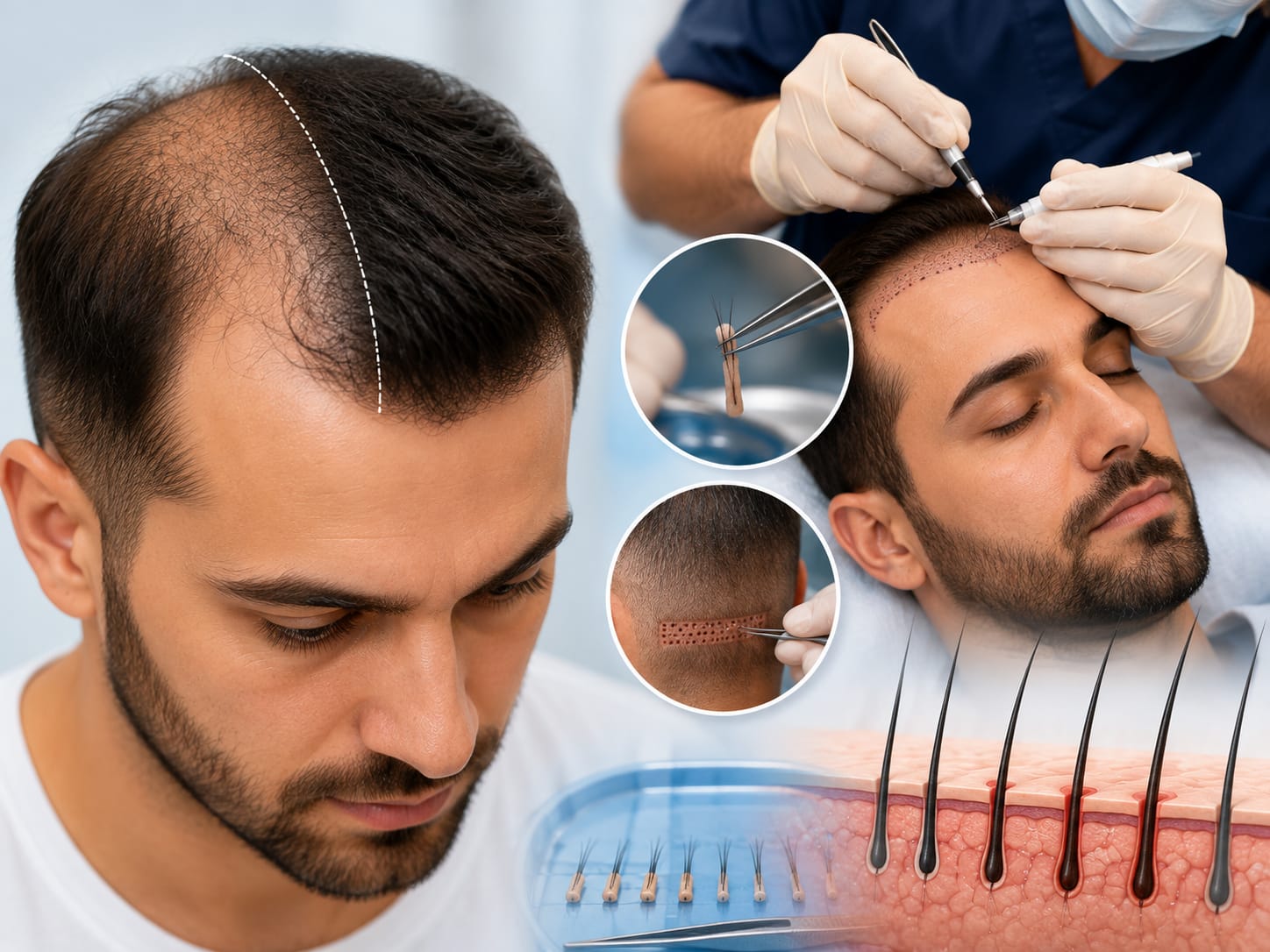
Hair transplantation moves healthy, active hair follicles from a donor area, usually the back or sides of the scalp. These follicles then go to areas experiencing thinning or baldness. Because donor-area follicles resist the hormone that drives pattern hair loss, transplanted hair usually keeps growing long-term in its new spot.
For a detailed clinical overview of current techniques, this peer-reviewed review of hair transplantation covers the procedure in depth.
FUE vs. FUT: The Two Main Techniques
Two techniques dominate modern hair transplantation, and each has distinct trade-offs.
Follicular Unit Extraction (FUE)
Individual follicles are extracted one at a time directly from the donor area, then implanted into the thinning region. Because no strip of skin is removed, FUE leaves no linear scar and generally allows for a faster recovery.
Follicular Unit Transplantation (FUT)
A thin strip of scalp is surgically removed from the donor area, then dissected into individual grafts under magnification. So FUT can yield more grafts in a single session. However, it leaves a linear scar and typically needs a longer recovery.
FUE vs. FUT at a Glance
| Aspect | FUE | FUT |
| Scarring | No linear scar | Thin linear scar at donor site |
| Recovery | Generally faster | Typically longer |
| Grafts per session | High, but more time-intensive to harvest | Can be higher in a single sitting |
| Best suited for | Those wanting minimal scarring, shorter hairstyles | Those needing a large number of grafts in one session |
Because both techniques have genuine strengths, the right choice depends on your donor supply, goals, and lifestyle, not a single universal answer.
Who Is a Good Candidate for Hair Transplantation?
Good candidacy depends on more than just wanting more hair. A few clinical factors matter significantly.
- Sufficient donor area density, with healthy, thick hair in the back and sides of the scalp
- A stable, predictable pattern of hair loss, rather than hair loss that’s still rapidly progressing
- Realistic expectations about density and natural-looking results
- Generally good scalp and overall health
Very young patients are often advised to wait, since future hair loss patterns can be difficult to predict early on, which affects long-term planning. Conditions like widespread, unpatterned thinning can also make someone a less ideal candidate.
When Transplantation Might Not Be the Right Fit Yet
- Hair loss that’s still actively progressing without a stable pattern
- Very limited donor area density
- Diffuse, all-over thinning rather than a defined pattern
- Active scalp infections or certain untreated medical conditions
In these cases, non-surgical options are often recommended first, either as a standalone approach or to prepare the scalp before considering surgery later.
What to Expect During the Procedure
- A detailed consultation, including donor area assessment and goal-setting
- Local anaesthesia to the donor and recipient areas
- Extraction of follicles, using FUE or FUT depending on your plan
- Precise recipient site creation, mapped to match your natural hair direction and angle
- Careful implantation of each graft
Procedures can take several hours to a full day, depending on the number of grafts involved.
Recovery and Results Timeline
- Days 1–7: Mild swelling and scabbing at the recipient site, which resolves gradually
- Weeks 2–4: Transplanted hairs often shed temporarily, which is a normal part of the process
- Months 3–4: New growth begins to appear from transplanted follicles
- Months 6–12: Density and thickness continue to improve
- Around 12–18 months: Final results become fully visible
The temporary shedding around weeks 2–4 often worries people, but it’s an expected phase, not a sign the transplant failed. The follicle remains, and new growth follows in the months after.
Supporting Your Transplant with Other Treatments
Many patients combine hair transplantation with complementary treatments to support results before and after surgery.
Our comparison of GFC vs PRP hair treatment explains regenerative options. These often support graft survival and overall scalp health.
If you’re still deciding whether surgery is necessary, our guide on receding hairline explains earlier-stage options. It also covers when transplantation becomes the more suitable path.
Is Hair Transplantation Safe?
When performed by an experienced surgical team, hair transplantation is considered a safe, well-established procedure with decades of clinical use.
As with any surgical procedure, temporary side effects like swelling, mild discomfort, or scalp tightness are common. Serious complications are uncommon when proper technique and aftercare are followed.
Common Myths About Hair Transplantation
| Myth | Fact |
| Transplanted hair looks unnatural. | Modern techniques transplant hair in small, natural-looking groupings, avoiding the obvious “doll hair” look of older methods. |
| Results are visible immediately. | Transplanted hair often sheds temporarily before regrowing, with full results taking up to a year or more. |
| Anyone can be a candidate. | Donor density, hair loss pattern, and overall scalp health all affect candidacy. |
| A transplant means you’ll never need other treatment again. | Existing, non-transplanted hair can continue to thin over time, so ongoing care is often still recommended. |
| FUE and FUT give the same results. | Both can give excellent results, but they suit different needs based on scarring preference and graft requirements. |
Frequently Asked Questions
Is hair transplantation permanent?
Transplanted follicles are typically resistant to the hormone that causes pattern hair loss, so results are generally long-lasting. Surrounding, non-transplanted hair can still thin over time.
How many grafts will I need?
This depends on the extent of your hair loss and your density goals. Your surgeon will estimate this during your consultation based on donor supply and the area to be covered.
Does hair transplantation hurt?
Local anaesthesia keeps the procedure itself relatively comfortable. Mild soreness afterward is common and manageable with standard aftercare.
How long is the recovery period?
Most people return to normal daily activities within a few days to a week. However, full results take several months, sometimes over a year, to fully appear.
Can women get hair transplants too?
Yes, though candidacy depends on the pattern and cause of hair loss. Diffuse, unpatterned thinning is generally less suitable than clearly defined areas of loss.
Should I try PRP or GFC before considering a transplant?
Often, yes. Non-surgical options are typically tried first for early to moderate hair loss. So transplantation gets considered once other approaches aren’t achieving the desired density.
Final Thoughts
Hair transplantation has come a long way from older, less natural-looking techniques. With the right candidacy assessment, technique, and surgical team, it offers a genuinely long-term solution for suitable patients.
Book Your Hair Transplant Consultation Today
If you’re exploring hair transplantation, the team at Dr. Pankti’s REVIVE Skin, Aesthetic, Laser & Hair Clinic in Borivali, Mumbai can help. We’ll assess your candidacy and walk you through the right approach for your goals.
Clinic: Dr. Pankti’s REVIVE Multispeciality Clinics
Location: Borivali, Mumbai, Maharashtra
Call: 9619758202